BMW EfficientDynamics Engine Family Explained by BMWBLOG
Munich, Germany – BMW discussed the new 500cc per cylinder engine compages that will serve as a edifice block for upcoming three, four, and in-line six cylinder gasoline and diesel engines. This common cylinder architecture allows for meaning shared componentry. It accounts for lx% shared components among gasoline variants and a like percentage amongst diesel variants, with 40% commonality between the diesel and gasoline variants.
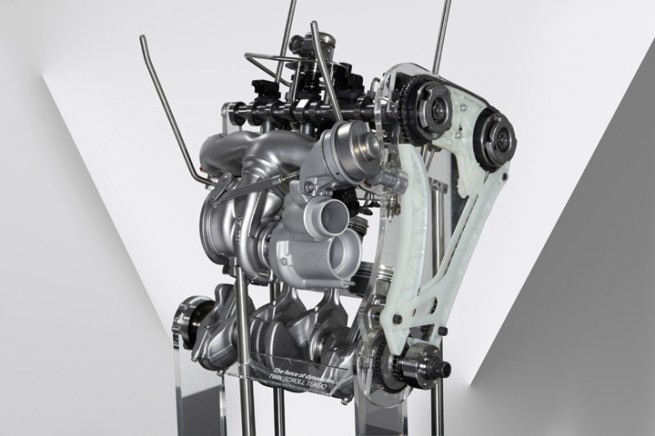
On the gasoline side of the family are cylinder heads that comprise BMW's 'TwinPower' attributes. TwinPower refers to variable valve timing and lift (VANOS and Valvetronic) combined with Direct Injection. TwinPower is enhanced by turbocharging, with either a unmarried turbo (3 cylinder), TwinScroll (four and six cylinder gas engines), or dual turbochargers for diesel variants.
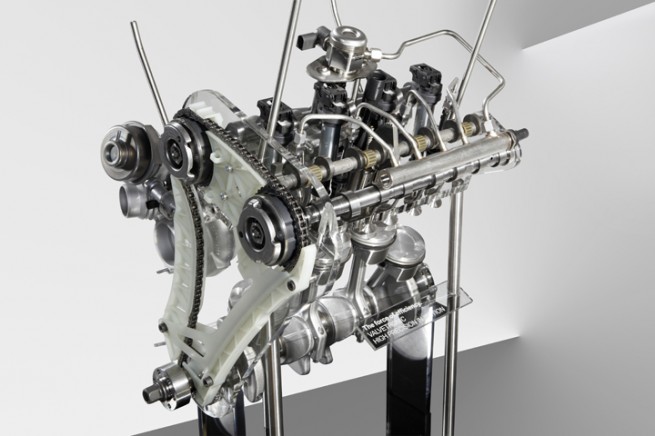
The directly injectors for the gasoline engines are of the solenoid variety and are not capable of stratified accuse. The N54B30 engine uses piezo direct injectors, but the N55B30 uses solenoid injectors. The N55 cylinder head architecture (VANOS, Valvetronic, and solenoid direct injectors) may, in some sense, be considered the direct antecedent of the cylinder caput architecture of the new engine family.
But the commonality of bore spacing, cylinder head bolt location, and bore and stroke allow for significant product process savings. The engines will be produced in Munich, Germany and Steyr, Austria. Considering of the common architecture the assembly lines can mix and match both diesel and gasoline engine variants on the same line (within some constraints) in club to meet demand. It will significantly reduce idle time in those facilities.
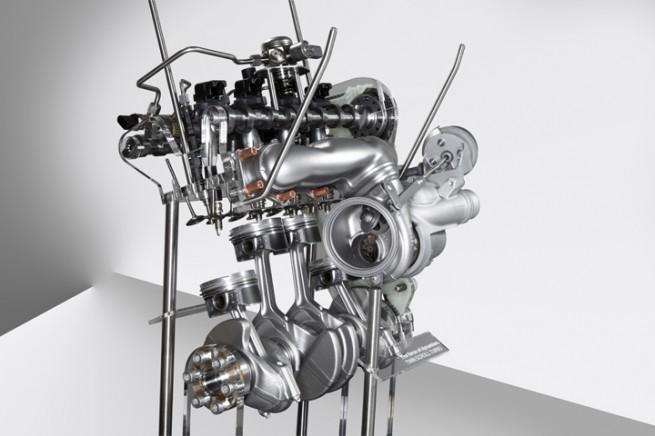
The output per cylinder is projected to exist in the 40 to 65 HP for the gas engines, and 27 to 54 HP for the diesel engines, torque will range from 44 lb-ft to 74 lb-ft for the gas engines and 55 lb-ft to 74 lb-ft for the diesel fuel engines. The specifics of power volition be adamant by the particular role the engine is called on to perform. Base of operations engines and engines used in hybrids volition be on the lower stop of the range and operation engines will occupy the upper reaches of the performance range.
In addition to longitudinal mounting for all engine variants, the three and four cylinder variants can be mounted transversely. Adapting the mutual architecture (with mutual cold and hot sides) allows for a 50% reduction in variations of engine/vehicle interfaces (radiators, air intake, exhaust routing, engine mounts, and climate control). That besides translates into reduced production costs.
Left unspoken during the presentation, but raised as a question is, what is the fate of the 8 and 12 cylinder engines. They live on (and are necessary) merely are not a part of this engine family. For 1 thing, the V configuration complicates adding them into a common associates line for the inline engines. And the 3,four, and 6 inline engines will exist in the bulk of the products BMW produces, with, I believe, the V8 and V12 playing an increasingly 'niche' office. After all the focus is to provide loftier specific ability on demand, with frugal operating characteristics under most driving conditions. It is the merely good way to meet e'er more stringent fuel economy and emissions targets imposed by governments.
Two additional tidbits of note, BMW was asked if a two cylinder was possible, and it is, but not currently nether consideration. And turbocharging is not a must – a naturally aspirated variant of the
engine family may be considered for certain niche applications, although the specific use of VANOS, Valvetronic, and direct injection favor theuse of turbocharging.
The video that BMW provides to illustrate the new engine family unit is a chip to cute for my taste, but it did illicit a few "aha's!" from the assembled journalists when the engine is shown existence rotated to fit a transverse mount.
Download the PDF presentation on BMW's EfficientDynamics Engine Family
Source: https://www.bmwblog.com/2011/04/11/bmw-efficientdynamics-engine-family-explained-by-bmwblog/
0 Response to "BMW EfficientDynamics Engine Family Explained by BMWBLOG"
Post a Comment