West Bass Opening Again in Fort Wayne Indiana
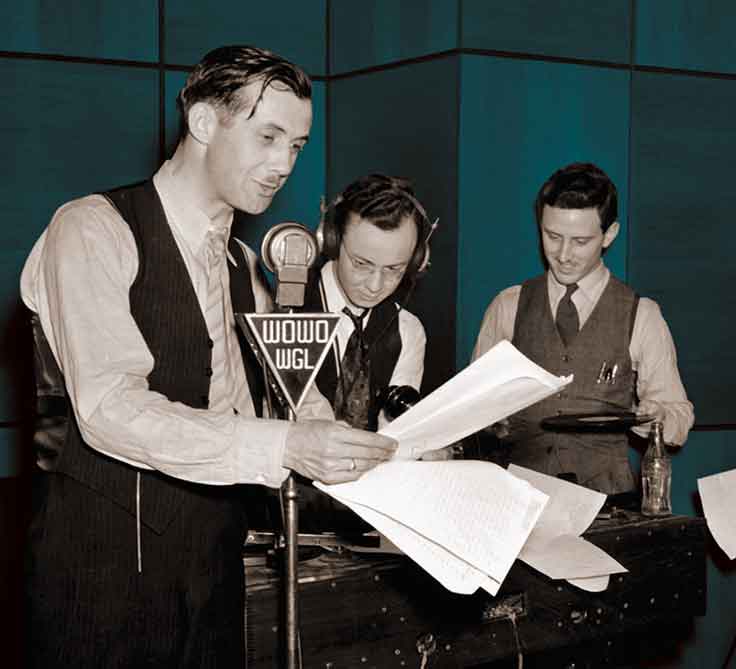
From Traces of Indiana and Midwestern History,Wintertime 2018. To receiveTraces four times a year, join IHS and savor this and other member benefits. Back issues ofTraces are bachelor through the Basile History Market place. Photo: first broadcast of basketball game play-by-play, IHS, WOWO Radio Station Photographs Drove, P 524.
Radio station WOWO in Fort Wayne first signed on the air on March 31, 1925, with 500 watts at 1320 kilocycles. The year before, musicians had gathered in the home of Harold Blosser at 2708 South Wayne Avenue for an experimental radio circulate, which included an opera vocaliser from Bluffton, the Allen County treasurer who did some old-time piffling, and others. Using a five-watt transmitter, the broadcast had a limited range, but it was a hit. Fred Zieg, owner of the Main Car Supply store in downtown Fort Wayne, had been looking for a way to promote the sale of Dayfan radios. He was pleased to receive hundreds of calls following this experiment. Kneale D. Ross, a salesman at the store, convinced Zieg that for $150 he could build a radio station above his shop at 213 Main Street—WOWO was born. A listener contest came up with the slogan "Wayne Offers Wonderful Opportunities."
The Indiana Historical Lodge William Henry Smith Memorial Library holds a WOWO Radio Station Photographs Drove (P 524), consisting of xc-8 blackness-and-white photographs that testify the station's facilities and staff members. The majority of photographs are not dated just have been determined to exist from the belatedly 1920s through the 1940s. The photographs show musicians, comedic performers, and announcers, equally well as programs that were performed in the presence of audiences, including The Hoosier Hop and Modern Home Forum. The starting time broadcast of a basketball game game play-past-play in the studio via Western Union ticker, the Human on the Street programme in front end of the Patterson-Fletcher Visitor shop, and a quiz show called Do You Know the Reply are also depicted.
In the 1920s there were few rules for radio, and it was a time of great creativity and experimentation. Listeners were then amazed past the sounds that came through their radios that hearing annihilation at all became entertaining. Radio gave everyone, rural and urban alike, access to a broader earth and new ideas. Beyond providing amusement, radio had the power to alert people to important news faster than newspapers could. During natural disasters, broadcasters organized relief efforts, provided vital information, and calmed fears. Equally Hilda Woehrmeyer, an employee of the Main Car Supply Company and later a WOWO broadcaster, said, "radio makes a neighborhood of a nation."
General Electric, Westinghouse, Amer-ican Telephone and Telegraph, and the Radio Corporation of America organized the National Broadcasting Company to provide national programming. NBC was the start full-service radio network in the U.s.. Its first circulate, at 8:00 p.grand. Eastern Standard Time on November 15, 1926, was a 4-and-a-half hour gala of the leading musical and comedy talent of the day originating at the Waldorf-Astoria Hotel in New York Urban center. Performers included Will Rogers, vaudeville comedy duo Joe Weber and Lew Fields, the New York Symphony Orchestra, Vincent Lopez and his
orchestra, and other trip the light fantastic bands. Airing over a network of twenty-v stations equally far w as Kansas City, nearly half of the state's five million homes with radios tuned in to the program.
The outset coast-to-coast circulate followed on New year'south 24-hour interval 1927, with coverage of the Rose Basin football game game in California. Beginning that day, NBC ran 2 networks, identified as NBC-Red and NBC-Bluish.
Radio stations provided their own local programs for a few hours a day. Through affiliation with a network they would fill other hours with national programming. Early in 1927, WOWO increased its power to 5,000 watts. On September eighteen, 1927, WOWO became a pioneer station of the CBS network forth with fifteen other stations. In 1928 Zieg bought another station that became WGL (What God Loves) and operated it from the WOWO facilities.
In 1928 the new Federal Radio Committee ordered almost stations in the state to change their broadcast frequencies at two:00 a.chiliad. Primal Time on November xi. The purpose was to reduce interference and generally add together some order to the growing radio industry. WOWO moved to 1160 kilocycles. The following April, WOWO's power was increased to ten,000 watts. At this time, the station shared its frequency with WWVA, a radio station in Wheeling, West Virginia. The two stations adhered to a schedule, with i station signing off before the other began its broadcast.
In the 1930s WOWO was the offset station to circulate a basketball game game and the get-go to air a Man on the Street plan, which information technology did from the anteroom of the One-time Indiana Theater. The Hoosier Hop was a weekly half-hour evidence on WOWO outset in 1932 that aired for more than than fifteen years except for an interruption during Earth War II. The bear witness had a rural flavor and offered such fare as traditional American folk music, square-dance music, and yodeling.
Bob Sievers spent his unabridged career at WOWO, kickoff signing on the air on December iv, 1932, when he was a freshman at South Side High School. His starting salary was five dollars per week. Through all 4 years of high school, he signed the station on the air each forenoon from the Gospel Temple later on completing his Fort Wayne Journal Gazette newspaper route. Sievers remembered having to walk up a long stairway to the second floor of the Main Auto Supply Visitor building to become to the WOWO studios. "I remember the one studio where we did a lot of announcing had old wooden doors that y'all closed," he said. "The rats chewed holes under the studio door where they could run in and out."
Sievers became a full-time announcer at WOWO on August two, 1936, the aforementioned calendar month that Zieg and his associates sold WOWO and WGL to Westinghouse. Sievers'due south v decades on the air were interrupted only past his military machine service during World War Two and the Korean War.
Howard D. "Tommy" Longsworth was hired equally a staff musician at WOWO in 1936. He recalled performing in the studio above the Main Auto Supply Company: "So, you had these little narrow stairs that you had to go up, and every time you did—according to what kind of an instrument you were carrying—yous would generally bang it on the wall, because there wasn't any lite going upwardly there. You lot finally got upwards to the end of this, and and then you came into a hall. At the end of i hall was what they called Studio A and the other end of the hall was Studio B." The studio was a room about twenty anxiety by xxx feet with no acoustical handling. Longsworth remembered having the window open in the studio on a hot twenty-four hour period and the dissonance from a car below on the street made "all kinds of dissonance. Then this went over the air, also. We would have to go over there real quick and slam the window downward so information technology wouldn't drown us out. . . . Yous just idea of information technology every bit you went along. It wasn't planned at all."
The station's engineering controls were in a small cupboard in the studio and the beginning transmitter was on the edifice's roof. A pocket-size room encased in glass allowed about v or half-dozen visitors to watch performances. Longsworth said he would hang out there waiting to see if he could get on the air if there was actress time or somebody failed to show upwards. He recalled barking like a dog for a program sponsored by Wayne Dog Nutrient and getting paid more than to do that than for playing his bass fiddle.
On May 1, 1937, WOWO joined the NBC-Blue Network, which became ABC in 1943. That aforementioned calendar month the station moved into new studios congenital by Westinghouse at 925 South Harrison Street. More than x,000 listeners visited the studios in the ii-day open up house and congratulatory messages were received from effectually the globe, including one from President Franklin D. Roosevelt. The station now had more than studios, and these had observation rooms that were tiered and could seat about fifty people. The studios themselves could concord 100 to 150 people for shows with live audiences.
Sievers said that audition participation was an important office of WOWO. He recalled:
For each studio that we had when we were on Harrison Street or on Washington Street, or even the original station downward on Main Street, for each program that we had, we would take a big observation room for people to sit there and watch the program. . . . For instance, Jane Weston conducted the Mod Home Forum ladies' program in the morning. Ladies would sit right in the studio and watch her bake. We always had a roving microphone where we would talk to the people in the audience. . . . I had a man on the street plan . . . from a number of dissimilar locations . . . and everybody would gather effectually the sidewalk, and I would introduce the testify by saying, "One moment, i moment, please."
Modern Domicile Forum was a habitation-maker show that aired on WOWO from 1937 to the early 1960s. It had a live studio audience most of the time and offered household hints and cooking lessons. Information technology was hosted by "Jane Weston," which was an air proper name used past several different women at WOWO over the years in homage to Westinghouse, the station's owner. The name was used on a number of Westinghouse stations for local homemaker programs. WOWO's first Jane Weston was Dorothy Wright, who was born in W Lafayette, Indiana, the daughter of Reverend Manfred C. Wright.
The popularity of programs was based on how much mail people in the show received. Whether the comments were negative or positive was not taken into account. Jane Weston offered a lot of giveaways to the audition, so she would receive hundreds of thousands of pieces of mail for that. In the daytime the station did local dissemination and advertisements. The network affiliations provided the big, prime number-fourth dimension evening shows, such equally Dragnet, The Shadow, The Ed Sullivan Hour, and Jack Benny.
In 1941 the Due north American Radio Broadcasting Agreement required most AM stations to change frequencies. This resulted in a massive shifting of radio-station dial positions across the land. A photograph in the collection shows WOWO staff every bit the station moved from 1160 to 1190 kilocycles at 2:00 a.thou. Central Time on Sat, March 29, 1941. That same year WOWO was authorized to stay on the air continuously total time. It aired national shows such as Fibber McGee and Molly and The Lone Ranger. Some of WOWO'southward local shows were also broadcast more widely through networks.
The Hoosier Hop was revived in July 1943 as a studio broadcast with a cast of about 15 people. By October information technology moved to the Shrine Auditorium in Fort Wayne, where a cast of more than 30 performed to crowds numbering 4,000. The cast also appeared at fairs, bond rallies, and other civic functions. On May five, 1944, the Hoosier Hop began to air on the Blueish Network to a wider national audition with a full 50-five-minute evidence.
The WOWO Photographs Collection includes several photos of Franklin Tooke, who began his dissemination career at the station in 1935. He became a Westinghouse employee the side by side year when the company bought the station. Beginning in 1946 he worked equally program director and general director at other Westinghouse stations in Pittsburgh, Philadelphia, Boston, and Cleveland.
Eldon Campbell was hired as an announcer at WOWO in 1938 and became plan director in 1941. He worked at WOWO until 1945, when he moved on to a station in Portland, Oregon. From 1950 to 1956 he was an executive sales representative with Westinghouse Broadcasting in New York City. In 1957 Campbell became vice president and general manager of Indianapolis'south WFBM radio and television (today WRTV), a position he held until 1973. He also taught a radio and television receiver management course at Butler University. In 1974 he became manager of the Department of Commerce for the Land of Indiana. He was active in Indianapolis civic affairs including the 500 Festival committee, the Boy Scout Council, and Junior Achievement. He was presented the Jefferson Laurels for outstanding public service in 1987 by the Indianapolis Star.
Hilliard Gates (born Hilliard Gudelsky) was hired as an announcer by WOWO in 1939. He remembered: "WO and WGL—nosotros were together in those days and came out of the aforementioned studios, but not the aforementioned programming. We were a Blue network NBC station—Red network on WGL. They were both owned by Westinghouse and they were broadcasting simultaneously. We didn't duplicate very often. Nosotros might on a July 4th parade or something like that—put it on both stations. We had sales people for WGL and sales people for WOWO. . . . The announcers did both stations." Gates said that when he showtime arrived at the station he asked, "How do you know if you're on WO or WGL?" The answer he got from the program director was, "Y'all'll know." Merely apparently it was not always clear. Gates recalled a time when "Sievers had to brand a station break, and he was in the berth where you say, 'This is WOWO Fort Wayne.' Yous know, NBC had the chimes, so you came in and said, 'This is WOWO Fort Wayne.' And ane noon, it was time for the station break, and Bob said, 'This is ah, ah, WOWO—no, this is WGL—no, it's WOWO.' Finally, he said, 'What the hell station is this anyway?'"
Gates was a sportscaster, announcing the high school games on WGL and the college games on WOWO. When Gates offset arrived in Fort Wayne, the station was broadcasting only basketball game. He convinced the station manager that WOWO could cover college football games. And then when the Pistons started to play professional basketball in Fort Wayne in 1941, WOWO aired all of its games until the team moved to Detroit in 1957.
Hoosier dissemination legend Tom Carnegie (born Carl Kenagy) started as an announcer for WOWO in 1942. He took a railroad train on the Wabash Railroad from Kansas City to Fort Wayne for an interview at WOWO and accepted the job and a salary of thirty-four dollars per week. At Kansas City radio station KITE he had been paid fifteen dollars per week for working a minimum of 60 hours a week while still in higher. WOWO programme manager Campbell had Kenagy alter his name when he started at the station.
Carnegie said that in the beginning of his fourth dimension at WOWO, he arrived at the station at 6:00 a.m., "ripped the news off the wire," organized the news himself, and then read it on the air at 6:30 a.m. Somewhen he was asked to join Jane Weston on the half-hour homemaker show at one:00 p.g. to ad-lib most recipes. He was paid an extra three dollars a calendar week for participating on that testify. In a 1994 interview, he recalled, "I took my offset three dollar talent fee and bought a coffee table. I volition always recollect that, and I nonetheless have that coffee table." He likewise remembered that the station was "originating programs regularly to both the Blood-red and the Blue NBC networks. Back in that era, the Red Network was the number ane network of NBC, and the Blue Network was trying to be established on its own. The Bluish Network somewhen became ABC, but they were both endemic past NBC at that fourth dimension.
"What a wonderful opportunity for me as a youngster to take lots of ballgames to practise, lots of opportunities for advertizement libbing, lots of opportunities for studio programs, for but unproblematic station breaks. No recorded station breaks—everything was alive. . . . Once in a while I would forget which station I was on. I would go into a studio, and that studio would be WOWO at that fourth dimension, and a one-half-hour later, it could be a WGL studio," Carnegie recalled.
NBC picked upward some of WOWO'south musical programs, such as The Hoosier Hop, which was performed by local country musicians who worked for the station as well as doing shows on the side. WOWO had a studio orchestra on staff, which was very rare.
Carnegie learned how to broadcast a basketball game by Western Wedlock ticker. The local National Basketball game League team at that fourth dimension was the Fort Wayne Zollner Pistons, owned by Fred Zollner who had a piston-manufacturing visitor. To save money, Carnegie did not travel to abroad games. A Western Union operator would sit in at the game in Oshkosh, Wisconsin, for example, and "would transport back dot-dash-dash, what was going on." Sometimes Carnegie would have to call a time-out, even when one was non really called at the game, just so he could grab up and figure out what was happening. He worked at WOWO for iii years. Carnegie was lured to WIRE in Indianapolis, where he became the chief announcer for the Indianapolis 500. He began to teach radio at Butler in 1949, and founded radio station WAJC there. In 1953 he moved to television, as managing director of sports for WFBM Aqueduct 6, a position he held until 1985.
WOWO increased its ability over the years and switched dorsum and along from AM to FM. There were also changes in ownership and programming format. In the 1950s radio got new competition for audiences from television set. People could now run across what was happening instead of simply hearing nearly it. The early days of boob tube mirrored the early days of radio in terms of people's amazement and the lack of sophistication of programming. On February one, 1954, WOWO's ability increased to 50,000 watts, as powerful as any station in the land. WOWO earned the nickname "The Voice of a Chiliad Main Streets" and became one of Indiana's all-time-known stations.
The station's personnel looked back on WOWO with fondness and appreciation. "My unabridged 50 years at WOWO, our staff, nosotros were really always like 1 large happy family," Sievers recalled. "Nosotros had our Christmas parties and our summer go-togethers at the lake and had cook¬outs—the engineers, the producers, the sales staff, all the different departments." WOWO had a booster society, a softball squad, and a basketball game team. The station played against other company teams, such equally General Electric and Magnavox. Gates said that the station's staff "was a family, and that's why they were so successful," and remembered that "the greatest grouping of people that I worked with in my radio career was the staff that Westinghouse assembled at WOWO in Fort Wayne."
Barbara Quigley is senior archivist, visual collections, for the Indiana Historical Social club William Henry Smith Memorial Library. Her article on the library's Lassen Family Photographs Collection (P 562) appeared in the summer 2017 issue of Traces. In 1999 the IHS Press published "In the Public Interest": Oral Histories of Hoosier Broadcasters, compiled and edited past Linda Weintraut and Jane R. Nolan. The volume includes interviews with such WOWO personnel as Tommy Longsworth, Bob Sievers, Eldon Campbell, Hilliard Gates, and Tom Carnegie.
Source: https://indianahistory.org/stories/dont-touch-that-dial-the-early-years-of-wowo-in-fort-wayne/
0 Response to "West Bass Opening Again in Fort Wayne Indiana"
Post a Comment