Amount of Beef From a Cow
- A carcass is comprised of lean (meat), fat (adipose) and os
- The caput, hide, feet, blood and viscera are not components of a carcass
- Carcass cutting yield is just one gene that influences the amount of take-home product
- Beef purchased from locker plants are typically sold as halves, quarters or split sides
Dressing Percentage
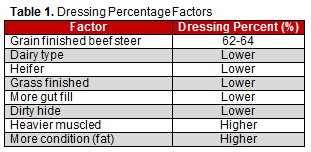
To improve sympathise the amount of meat yous may expect from a finished beef animate being, the first step is agreement the departure in live weight compared to carcass weight. When a beefiness fauna is harvested certain components of the brute such equally the head, hibernate, feet, blood, and viscera (internal organs) are removed. The remaining lean (meat), fat (adipose), and os, makes upward the carcass hanging weight. Computing dressing percentage will help determine how the carcass may yield from the live brute and will exist influenced by many factors such every bit muscle score, genetics, amount of fill, and more (Table 1).
Dressing Percentage = (Carcass weight/Alive weight)*100
Carcass Fabrication
The next thing to consider is more weight will be lost when a carcass is fabricated, or broken down into smaller (i.e. retail) cuts. The pct of carcass weight remaining equally "take-domicile" product is chosen the carcass cutting yield.
Of import Note: Water Loss
Hot carcass weight is the weight of a carcass prior to chilling. A beef carcass consists of 70 to 75 per centum water. Every bit the carcass chills and ages, water will exist lost through evaporation. In simply the first 24 hours a carcass tin can lose up to 2 to 5 percentage of its initial weight.
Chilled Carcass Weight * Carcass Cutting Yield = pounds of "take-home meat"
Carcass cutting yield is variable and depends on the carcass's fat thickness (leaner carcasses have a more desirable and college carcass cutting yield), muscling (the greater the muscling the higher the yield), and the amount of bone-in versus boneless retail cuts. Deboned, or boneless, retail cuts volition lower the carcass cutting yield (Table two).
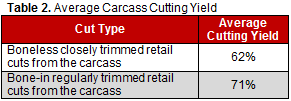
Requesting closely trimmed and boneless steaks and roasts and/or trimmed, lean (90:10, lean:fat) ground beef will result in less pounds of take-home product. This may be advantageous depending on freezer space availability and eating preferences. It is important to understand that the amount of edible meat volition be the same regardless if the retail cuts are boneless or bone-in.
Choosing to bring abode organ meats such as liver, heart, and natural language will also influence the pounds of meat production you accept-home.
Agreement Primal vs Retail Cuts
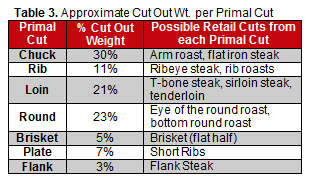
The start cuts made to a whole carcass are to separate the carcass into primal cuts (Figure 1). Each fundamental cut will be further made into a diversity of bone-in or boneless retail cuts. For instance, the loin may exist broken down into bone-in rib, T-bone, porterhouse, and sirloin steaks with boneless alternatives while the chuck may be cleaved down into bone-in or boneless chuck and arm steaks and/or roasts, and/or stew meat (Table three). Ground beef comes from trimmings of multiple primal cuts especially the chuck and round due to their muscle construction and lack of tenderness. Footing beef can too exist farther processed into specialty meats such as summertime sausage and snack sticks.
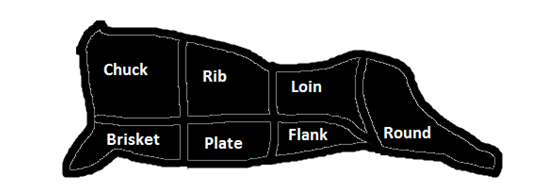
Figure 1. Beefiness Primal Cuts
Purchasing Locally Raised Beef
Many farmers and locker plants sell beef by halves, quarters, or split up sides. Beef carcasses are split down the spine into 2 halves for easier treatment, ameliorate chilling, storage and aging processes – this results in what is referred to as 'a half of beef'. When determining roughly how much meat you should look from a half of beef, accept the pounds of meat previously calculated for the entire carcass and divide by two.
When buying a quarter of beef you are either buying an entire forequarter or a hindquarter from one of the one-half sides. If y'all purchase a forequarter you lot will receive cuts from the chuck, rib, brisket, and plate. If you purchase a hindquarter y'all volition receive retail cuts from the loin, round, and flank. It is important to empathize that if y'all buy a hindquarter you will not receive cuts from the chuck, rib, or brisket such as arm roasts, chuck roasts, ribeye steaks, etc.
Some farmers and locker plants will sell a carve up side meaning you are purchasing a quarter of the meat with an assortment of cuts from an entire side. This pick is desirable if yous want certain cuts from both the fore- and hindquarters.
Example Meat Yield Calculations
- Live weight x typical dressing percent = hot carcass weight 1200 lb 10 62% = 744 lb
- Hot carcass weight x (100 – compress) = chilled carcass weight 744 x (100% – iii.v%) = 718 lb
- Chilled carcass weight 10 carcass cutting yield percent = pounds of have home product 718 lb x 67% = 481 lb
For More than Information
Contact your local Extension Educator; Wisconsin Department of Agriculture, Trade and Consumer Protection; or Wisconsin Beef Council.
References
Beefiness Cuts: Key & Subprimal Weights and Yields. 2013. Beef Checkoff. Print. Access Date: June 10, 2020.
Aberle, Elton David. Principles of Meat Science. 4th ed., Kendall/Hunt. 2001.
Coyne, J.M.; R.D. Evans; and D.P. Drupe. 2019. Dressing percentage and the differential between live weight and carcass weight in cattle are influenced by both genetic and non-genetic factors. J. Anim. Sci. 97(4):1501-1512.
The netherlands, Rob; Dwight Loveday; and Kevin Ferguson. How much meat to look from a beef carcass. Academy of Tennessee Extension. Print. Admission Appointment: June ten, 2020.
Thiboumery, Arion; Kristine Jepsen; and Kristi Hetland. 2013. Beef and Pork Whole Brute Ownership Guide. Iowa Country University Extension and Outreach. Impress. Access Date: June 10, 2020.
Wulf, Duane M. "Did the Locker Plant Steal Some of My Meat?" South Dakota Land University. Print. Access Date: June 10, 2020.
Download Article
Source: https://livestock.extension.wisc.edu/articles/how-much-meat-should-a-beef-animal-yield/
0 Response to "Amount of Beef From a Cow"
Post a Comment